
北京 A—Z 城市指南
Beijing is a city as poetic as it is practical. Its name—Bei (North) Jing (Capital)—is a geographic indication, a compass point disguised as a title. There was a time when only the Emperor, his family and their attendants could pass through the gates of the Forbidden City; today the palace is open, and so is Beijing itself, and there is much to do. Paper holds thoughts; printing shares them; the compass tells you where to venture next. Beijing invented all three, among many, many other things. Together they form a sort of cultural tripod upon which the city rests, and a vantage point from which one might begin to understand it. Here you cannot fly a kite (another Beijing invention) without bumping into a UNESCO World Heritage Site—there are eight in the city. And yet, Beijing is not defined by its monuments, but by how they make you feel when you are standing beside them.
A—Z 不私藏地圖
Atelier Suasua
Our partners in time, design, and sentiment—the imagination behind Aesop WF Central House 19.
B302, Jucai Building, No.76 Caoyuan
Hutong, Dongcheng District, Beijing
Brick Art Museum
If circles and bricks are your thing, make your way to this terracotta warren of spherical geometry. Picture Peter Zumthor after a summer learning Mandarin.
Chaoyang, China, 100103
Compass
Created during the Tang Dynasty, a compass was used for directional divination. Fast forward a few centuries, and it is still used in digital divination. Set your ‘Luopan' toward the Beijing Observatory to discover early examples.
China, Bei Jing Shi, Dongcheng, 东裱褙胡同2号 邮政编码: 100005
Dress
Oscar Ouyang and Dingyun Zhang. Two local designers with threads worth following.
instagram.com/oscarouyang.official instagram.com/dingyun_zhangExchanges at Jizhi Tea Shed
Before screens, news brewed in cups. Teahouses remain an analogue internet: places where romances ferment, and storytellers steep new yarns. At this particular establishment, history meets the present, and a local tradition finds shelter in a foreign courtyard—where a fourth-generation teamaker ensures cups steam year-round.
Xinzhuang Village, Changping District, Beijing
Film
Beijing’s cultural, philosophical and architectural diversity is an ideal growth medium for great cinema, as exemplified by the ten films gathered by the British Film Institute at bfi.org.uk/lists/10-great-films-set-beijing
bfi.org.ukGreat (Walls and Otherwise)
Four great inventions, the eight great traditions, a great many miles of wall. And the greatest of all musical and actorial exports: Faye Wong, patron saint of atmospheric longing. We have watched Chungking Express and 2046 as many times as we have listened to her Cantonese cover of ‘Dream Person’, which is to say, a great many.
youtube.comHutongs
An alley where history is rewritten. Within the Lanman Hutong, old walls now wear flowers and murals. Here, a bookstore opens its rain-curtain door to the lane, coffee steams beside it, as the White Pagoda watches from the west.
Lanman Hutong, Xicheng District, Beijing
Ink
Having invented paper pressing, China knows how to measure aword. Beijing-born Bei Dao and Bei Ling are two poets who both know the worth, and weight, of words.
poetryfoundation.org poemist.comJianbing
Breakfast as architecture. Crisp, warm and folded. Best eaten at 7 a.m. on the street.
Kites
Paper, again. Beijing’s traditional kite makers such as those at Three Stone Kite turn wind into sculpture. Join the octogenarians ogling over theirs in the park. Procrastination perfected for children or the child within.
China, Beijing, Xicheng District, 地安门西大街甲25
Libraries
Beijing City Library, National Library, Liyuan Library. Etch yourself into each part of this literary triptych.
Beijing City Library: Building 3, No.1 Lvxin Road, Tongzhou District, Beijing
National library of China: No.33 South Zhongguancun Road, Haidian Distict, Beijing
wikipedia.orgLiyuan library: Zhihui Valley, Jiaojiehe Village, Yanxi Town, Huairou District, Beijing
tripadvisor.comMusical Street
Here, violins, erhu and brass instruments hang in shop windows—a condensed orchestra waiting to be tuned. When walking along this lane, you can hear the testing notes of a suona or pipa, becoming the city’s improvised soundtrack.
Xinjiekou South Street, Xicheng District, Beijing
Nature: Chapel of Sound
Get out of town and head to the sonic sanctitude of the Chapel of Sound. Appearing as a precariously balanced boulder, this monolithic open-air concert hall is within earshot of the Ming Dynasty era Great Wall.
Luanping, Chengde, Hebei Province
Olympics, 2008
The Beijing 2008 Opening Olympics Ceremony is worth watching 2008 times. Perhaps the closest any country has come to writing a thesis through mass movement. Criterion has released a record-breaking amount of Olympic footage from the early days of the event to Papaioannou's gorgeous return in Athens.
Beijing Olympics Park, Chaoyang District, Beijing
Panjiayuan
A sprawling field where the city's layered past surfaces in fragments. Not a market, but an archaeology of the mundane; a place where time is bartered, and every object holds a quiet, dusty story of a home it once knew. Some of the decorations in Aesop WF Central House 19 came from here.
58 Yangrou Hutong, Xicheng District.
Quire
Mr. Chu Paper Studio is named for the paper of the ’Chu tree’. Its shelves are a topographical map of the country, each sheet a testament to a local paper-making, all holding silent their own weather and light. On weekends, lessons in forming, brushing and folding guide dextrous hands in the quiet science of turning paper into artware.
No.20 Zhaofu Street, Dongcheng District, Beijing
Rem Koolhaas
Sitting in Le Dauphin in Paris, designed by Rem Koolhaas, about to tuck into a sole meunière, this Senorialist was flashed with a phone displaying a picture of the CCTV Headquarters building in Beijing. 'A cabdriver thought it looked like boxer shorts and that’s now its nickname’, they were told. There you go. Visit if you can, and also: do not let anyone see you using your phone at the table, it is about as charming as being caught with your pants down.
East Third Ring Road
Guanghua Road
Beijing
Space of Time Gallery
A quiet gallery on the outskirts, that serves to answer musician Jim Croce’s wish to 'save time in a bottle.'
Zhaozhuang Village, Shunyi District, Beijing
Temple Fahai
Painted over 580 years ago by imperial court artists, this temple features vibrant frescoes of spiritual depth and meticulous detail—earning them their reputation as ‘the crown of Ming temple art.’
No. 23, Shatan North Street, Beijing, BJ, China
UCCA
‘Ullens Centre for Contemporary Art’ is a bit of a mouthful. One of China’s earliest private museums.
4 Jiuxianqiao Rd, Chaoyang, Beijing, China, 100102
Views of the Sky
The Ancient Observatory: pre-telescopic instruments that double as sculpture.
China, Bei Jing Shi, Dongcheng, 东裱褙胡同2号 邮政编码: 100005
Wu Wei
Not strictly from Beijing, but felt throughout. Effortlessness as philosophy; a useful approach in a city of twenty-two million.
wikipedia.orgXu Bing
The artist and former vice-president of the Central Academy of Fine Arts Beijing created, among many sublime works, Book from the Sky, which reads like scripture written in a dream.
xubing.comYards (Siheyuan)
Courtyard houses. Architecture turned inward, reflective, precise—and the setting for Aesop WF Central House 19.
Courtyard 1, House 19, West end of WF Central, No. 269, Dongcheng District
ZhiFengTang Bee Museum
A small museum that creates quite the buzz.
Yard 137, Shuangying Middle Road, Nanshao Town, Changping District, Beijing
城市感官漫遊
-
In traditional Chinese, ‘听' is written as 聽', composed of ‘耳' (ear) and ‘王' (king), suggesting that the ear receives what is most important. Beijing-born and beloved abroad, Faye Wong’s voice is precisely the kind of information we seek—particularly her rendition of The Cranberries’ Dream Person. On a different note, Beijing Rocks follows a group of aspiring musicians navigating the trials of making it big, offering a grittier soundtrack to the city. If you are in town, Lantern Club—especially during techno diva Li’s sets—will leave your lobes positively ringing. For something more sedate, follow the sound of the two-string fiddle, the jinghu, a Beijing invention that has been resonating a while, heard in Beijing Opera.
-
Would we be drinking our house-blend spearmint and liquorice root tea (you must try it) in Aesop stores from Berlin to Beijing, were it not for China? Possibly not. Prior to Chinese intervention some centuries ago, tea was eaten rather than drunk. As the story goes, Bodhidharma removed his eyelids in order to remain awake during meditation; where they fell, the first tea plants grew. Pu’er tea is aged and fermented—a mountain in the mouth—arriving compressed into discs and once used as currency. Yet it is oolong that commands particular reverence. They say good oolong has a good echo: it stays with you long after it is finished. Tea was—and still is—consumed for medicinal purposes, anti-oxidant efficacy chief among its many benefits. But for us, enjoyment sits firmly at the top of the list.
-
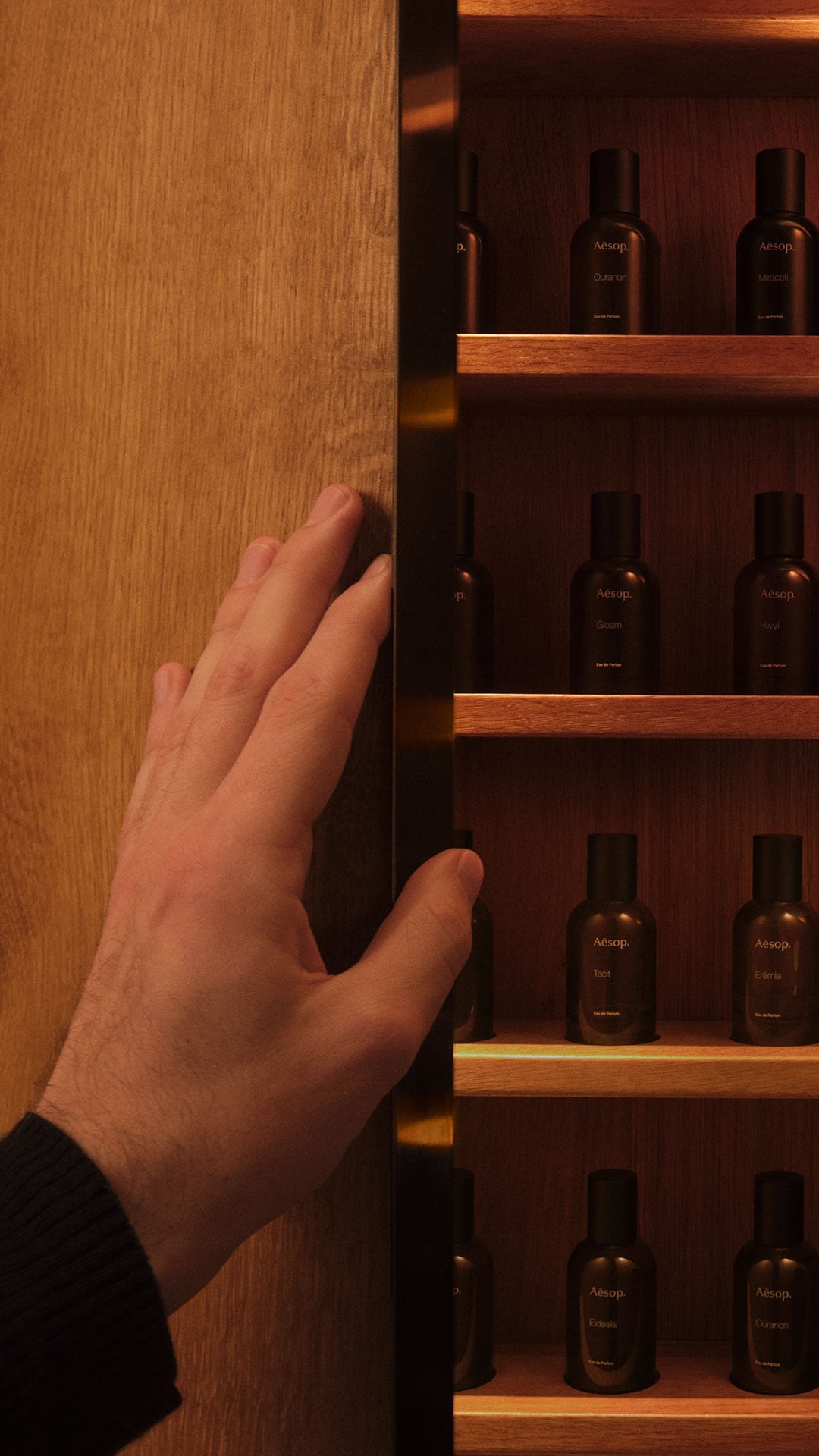
Juhani Pallasmaa’sThe Eyes of the Skin—a steady syllabus for new Aesopians since 1996—prophetically spoke to the ocular-centric world in which we now live. Today, eyes tend to consume rather than perceive. Enter: smell. At Aesop, our stores, offices, and acolytes are often smelled before they are seen. So it made perfect sense that when designing our first Beijing store in collaboration with atelier suasua, the entire East Pavilion would be dedicated to a Sensorium: an invention of our midnight musings that invites an intimate encounter with fragrance. Occupying a traditional siheyuan courtyard residence in Beijing’s Wangfujing district, it is a space worth sniffing out.
-
This section is best read while Brian Eno’s Kite Stories (1999) hovers quietly in the background—perhaps the finest way of seeking new heights while keeping one’s feet firmly on the ground, second only to the real thing: kites. Invented over 2,000 years ago, kites were originally used as a means of communication, particularly for military purposes. There are four steps to making a kite; the fourth being to fly it. Yī requires wood carving and bending over an alcohol lamp; Èr, the application of paper; Sān, the design; and Sì—then you’re as good as gone with the wind. Should aviation engineering not appeal, one can acquire a fine exemplar from Three Stone Kites, run by fourth-generation kite makers, a string’s length from the Forbidden City.
-
Whether unable to pay a visit to the city soon, or settled in Beijing during one of its harsh winters—when 8°C passes as warm—the city may also be explored via the screen. So pour a pot of oolong and go couch surfing: Liu Jiayin’s Oxhide (Parts I and II), intimate portrayals of the filmmaker’s family and apartment centred around dumpling-making, are tender and quietly revelatory. Farewell My Concubine is essential viewing and best paired with tissues, to collect one’s tears. So too are the films of Jia Zhangke, a graduate of the Literature Department at the Beijing Film Academy and much beloved in our fragrant halls: Ash Is Purest White and A Touch of Sin among them. Moving elsewhere, but with equal intimacy, A Chinese Tongue is a documentarian Hors D'oeuvre by Laurie Wen, who invites women she meets in Chinese grocery stores to cook and eat with her.